Surface preparation is one of the most persistent bottlenecks on any fabrication or maintenance floor. Media blasting and chemical stripping remove rust and paint, but they also remove healthy base material, introduce environmental hazards, and shut down production areas for hours. Facility managers need a cleaning method that removes contaminants without altering the part’s dimensions or microstructure. Selective laser ablation does exactly that — a pulsed fiber laser cleaning machine uses short, high-energy light pulses to vaporize unwanted layers while leaving the base material untouched. This article breaks down, from an operator’s perspective, exactly which surfaces and contaminants the technology handles, which ones it does not, and how to check a machine’s suitability before you buy.
Key Takeaways
- Pulsed fiber laser cleaning works by selective ablation: it relies on the absorption-threshold difference between the contaminant and the substrate.
- It excels at rust, oxide films, paint, grease, weld scale, soot, and adhesive residues on steel, aluminum, ceramics, and glass.
- It is not a universal tool — highly reflective metals, combustible organics, and thick soft polymers need different wavelength tuning or alternative methods.
- Machine evaluation should be based on pulse duration, frequency, peak power, and throughput matched to your specific surface–contaminant combination, not wattage alone.
The Physics of Selective Ablation: Why the Substrate Stays Intact
Laser cleaning works through two simultaneous mechanisms. First, the photothermal effect: the focused beam hits a dark, rough contaminant layer, which absorbs the photon energy and its temperature spikes instantly, converting the contaminant directly to vapor. Second, the photomechanical effect: rapid thermal expansion creates a microscopic shockwave at the contaminant–substrate boundary that physically breaks the mechanical bond and ejects the material. A fume extraction system captures the vaporized particles so they do not redeposit.
The reason this is safe for your parts comes down to the ablation threshold. Every material needs a specific energy density (fluence) to vaporize. Rust, carbon soot, and grease absorb infrared light readily and have a low threshold; solid metal substrates reflect most of the 1064 nm beam and conduct heat efficiently, so they have a much higher threshold. The laser is calibrated to sit between the two: strong enough to vaporize the dirt, too weak to melt the metal underneath. Once the contaminant is gone, the beam simply reflects off the clean substrate — the process is self-limiting.
This is also why pulsed lasers are the right tool and continuous wave (CW) lasers are not. A CW laser pumps continuous heat into the material, which warps thin sheet metal and creates a large heat-affected zone. Pulsed lasers release energy in nanosecond bursts, letting the substrate cool between pulses, so heat never accumulates. For precision cleaning, pulsed technology is the only safe choice.
Contaminants a Pulsed Fiber Laser Cleaner Handles Well
Rust, Oxidation Layers, and Oxide Films
Rust removal is the most common industrial application. The laser targets the dark, porous iron oxide and vaporizes it without removing healthy steel underneath — whether it is light flash rust on machined parts or heavy mill scale on structural steel. It also removes the transparent oxide films that form on aluminum and interfere with TIG/MIG welding, preventing porosity in the finished weld and preparing surfaces for grounding, NDT inspection, painting, or passivation.
Paints, Epoxies, and Industrial Coatings
Aerospace primers, automotive e-coats, and marine epoxies can be stripped layer by layer. By adjusting pulse frequency and scanning speed, operators can remove a weathered clear coat while leaving the base color intact, or strip everything down to the anti-corrosion primer. That depth control is physically impossible with blasting, and it saves significant masking effort and material cost during remanufacturing.
Oils, Greases, and Hydrocarbons
Machinery, CNC lathes, and stamping presses accumulate grease and hydraulic fluid that normally requires toxic solvents. Pulsed lasers break the hydrocarbon bonds at a molecular level and vaporize the residue, leaving parts dry and grease-free — with no solvent disposal, no fire hazard, and no secondary waste. It is widely used in food-processing environments and automotive parts remanufacturing.
Weld Scale, Soot, and Carbon Deposits
Post-weld heat tint on stainless steel, hard silicate islands on weld seams, and carbon buildup in injection molds are all excellent targets. Laser cleaning removes weld discoloration without micro-scratches that become future corrosion points, and it cleans mold cavities while they are still hot in the press, extending tooling life and keeping dimensional tolerances.
Adhesives, Sealants, and Rubber Residues
Thin layers of glue or tape residue ablate cleanly. Thick polymers behave differently: they absorb the shockwave and can melt rather than vaporize, so operators use multiple fast passes with heat control. Sign shops remove decal adhesive from metal panels; tire manufacturers clean vulcanized rubber flash from curing molds without wearing down tread patterns.
Standard operating procedure for coating removal:
- Verify the base material can safely handle a 1064 nm wavelength without absorbing excess heat.
- Identify contaminant thickness to set initial focal length and energy density.
- Start at lower power and higher scanning speed as a safe baseline.
- Run a test patch on an inconspicuous area and monitor substrate temperature.
- Adjust frequency and pass overlap until the contaminant vaporizes cleanly.
- Keep the fume extraction running throughout the pass.
Compatible Substrates: Where Pulsed Fiber Lasers Excel
| Substrate | Ideal contaminants | Parameter notes | Damage risk |
|---|---|---|---|
| Carbon steel & iron | Heavy rust, thick paint, mill scale, grease | High energy, longer pulses acceptable | Very low |
| Aluminum & titanium | Oxide films, light paint, pre-weld prep | Short pulses, fast scan speeds required | Low (with proper tuning) |
| Ceramics & glass | Soot, baked-on grease, adhesives | Low heat input; relies on optical transmission | Low (avoids thermal shock) |
| Stainless steel | Heat tint, weld scale, oxides | Medium energy; avoid edge overheating | Low |
Clear glass and many ceramics transmit or reflect 1064 nm light, so the beam passes through the base material and only interacts with the dirt on the surface. That is why commercial kitchen tiles, architectural glass, and high-voltage ceramic insulators can be cleaned without shattering or thermal shock.
Limitations: Surfaces and Contaminants to Avoid
- Highly reflective metals (copper, brass, polished aluminum): they reflect the infrared beam back toward the source, which can damage the laser oscillator and makes cleaning inefficient. Green (532 nm) or UV lasers are the correct choice for these materials.
- Wood, paper, and standard plastics: they absorb 1064 nm rapidly and lack the thermal conductivity to dissipate heat, so the substrate chars or catches fire before the contaminant is gone. CO₂ lasers or chemical/dry-ice methods are better suited.
- Thick, soft polymers (silicone caulking, polyurethane liners, rubber blocks): the material absorbs the shockwave and melts into a sticky mess instead of fracturing. Removal requires hundreds of passes, making it slow and thermally dangerous — mechanical scraping or cryogenic methods are more effective.
Procurement Checklist: What to Verify Before Buying
- Confirm the machine’s pulse duration and frequency range match your dominant contaminant type (thin flash rust wants different settings than heavy mill scale).
- Ask for a proof-of-concept test on your actual contaminated parts, not clean test coupons, and measure cleaning speed in m²/h for your specific combination.
- Check the extraction system’s CFM rating and filter type — ablated rust and paint generate hazardous dust that must be captured at the source.
- Verify the protective lens is replaceable and the supplier stocks spares; lens cleaning is your main recurring maintenance.
- Confirm power requirements (single vs. three phase) and cooling method (air vs. water chiller) against your facility.
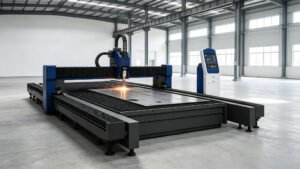
- Ask whether the same laser source can be upgraded from hand-held to gantry or robotic integration later, so the investment scales with your production.
Common Pitfalls We See on Shop Floors
- Buying on wattage alone: a 200 W unit with the wrong pulse settings can outperform a 500 W unit on thin coatings, and vice versa on heavy rust.
- Ignoring the line-of-sight constraint: the beam cannot reach inside blind holes or sharp internal corners; plan for robotic articulation or accept manual prep for those features.
- Running CW lasers on precision parts: continuous output acts like a blowtorch and warps thin material — specify pulsed for any dimensional-critical work.
- Under-specifying extraction: without high-vacuum extraction, vaporized contaminants redeposit and quickly foul the protective lens, degrading cleaning quality and shortening optics life.
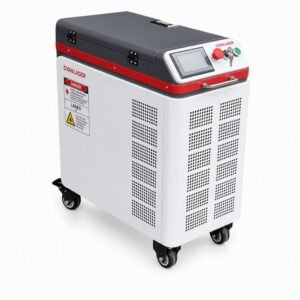
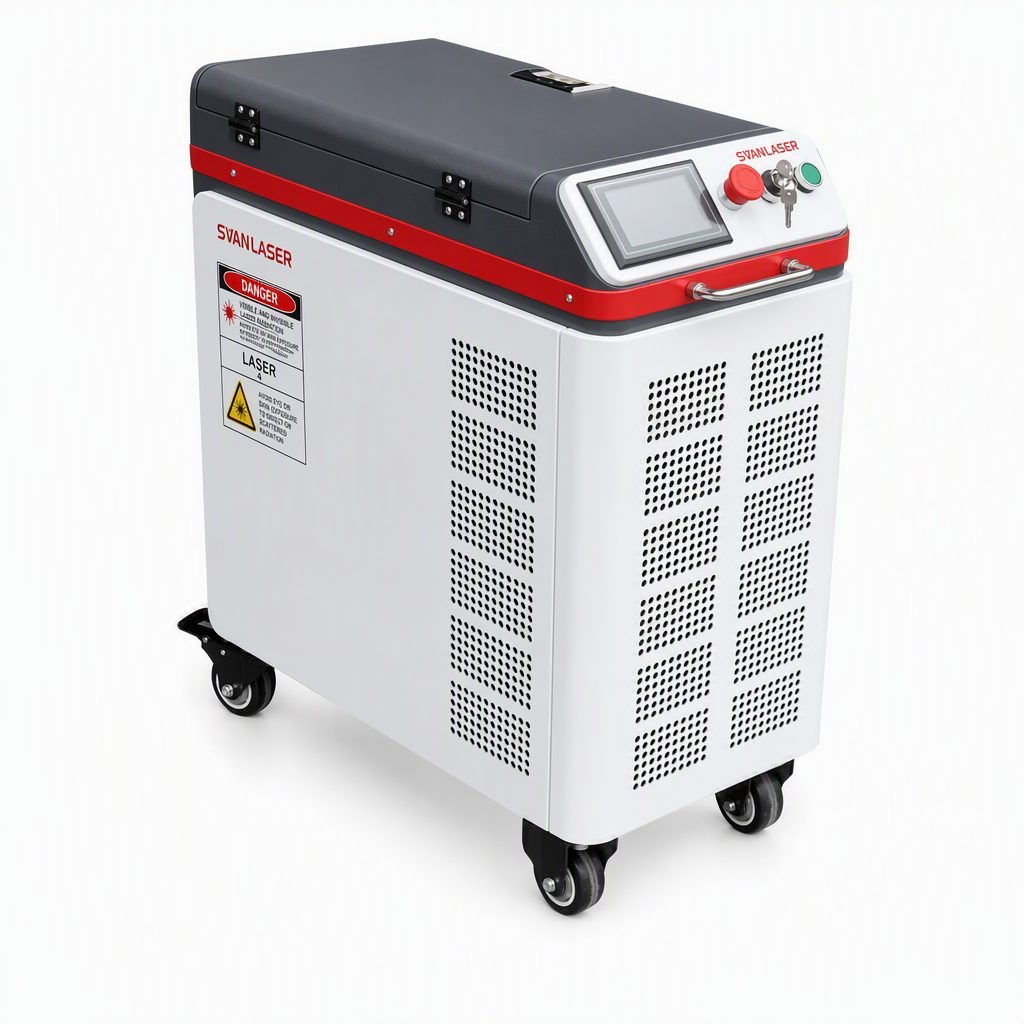
If you are evaluating equipment for your own material mix, our pulsed fiber laser cleaning machines are available for ablation trials on your parts. For production-line and high-volume requirements, an automated laser cleaning system may be the next step up.
FAQ
Q: Can a pulsed fiber laser clean aluminum without damaging it?
A: Yes, with correct tuning. Aluminum has a low melting point, so it needs shorter pulse durations (e.g., 50 ns) and faster scan speeds to prevent micro-melting. Properly tuned, it gives excellent pre-weld preparation with zero porosity in the weld.
Q: Why can’t a standard fiber laser clean copper?
A: Polished copper reflects the 1064 nm wavelength almost entirely, so the energy bounces back toward the source instead of cleaning. This back-reflection can damage the laser oscillator. Green or UV wavelength lasers are needed for reflective metals.
Q: Does laser cleaning damage the base metal?
A: When the laser is calibrated between the contaminant’s and the substrate’s ablation thresholds, the beam self-limits: it vaporizes the contaminant and reflects off the clean metal. No heat-affected zone, no dimensional change, no surface profile alteration.
Q: How fast is laser cleaning compared to sandblasting?
A: For precision industrial work (weld seams, molds, automotive frames), a correctly sized pulsed laser meets or beats dry-ice blasting throughput with far less logistics. Aggressive heavy epoxy stripping in open yards can still favor blasting; evaluate on your own parts.
Q: What maintenance does a pulsed fiber laser cleaning machine need?
A: Minimal: clean or replace the protective lens regularly (the main recurring cost), check the chiller fluid, and service extraction filters. There are no abrasive media or chemical consumables to buy.