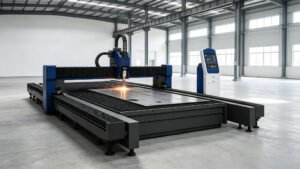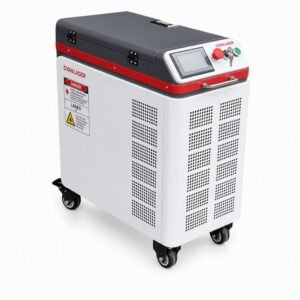
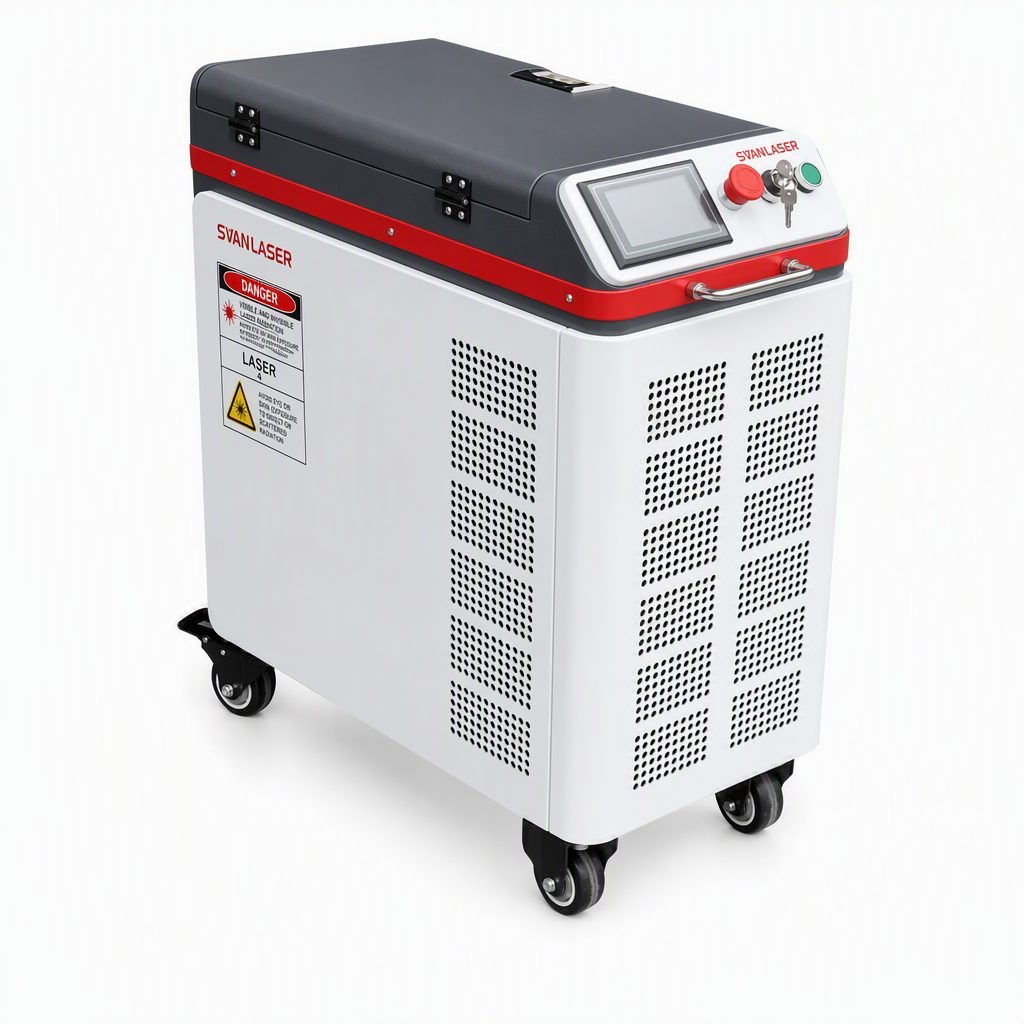
Industrial surface preparation hides compounding costs that erode margins: excessive labor hours, continuous consumable purchases, hazardous waste disposal fees, and extended equipment downtime. Many facilities outsource cleaning instead, paying high hourly rates and losing scheduling control. Bringing the process in-house with an automated laser cleaning system replaces unpredictable variable costs with a low-operating-cost asset that scales with production. This article quantifies the switch — what manual preparation actually costs, what laser automation costs, and how to calculate the payback period for your own operation.
Key Takeaways
- Laser cleaning operating costs drop to roughly $0.50–$3.00 per hour, eliminating abrasive media, chemicals, and specialized PPE.
- Pulse lasers remove contaminants via precise ablation thresholds, leaving the substrate unaltered and eliminating rework.
- Automated systems integrate directly into robotic cells or CNC lines, removing manual bottlenecks from the production cycle.
- Mismatched equipment (wrong wattage or pulse settings) extends cycle times and can damage parts — vendor proof-of-concept testing is essential before purchase.
The True Cost of Manual Surface Preparation
Manual cleaning costs are hidden in the details. You must count not just grinding or blasting time, but the hours operators spend masking precision surfaces, applying solvents, waiting for dwell times, and cleaning up afterward. A single large mold can take two operators several hours to prepare manually — multiply that by your fully burdened labor rate across hundreds of cycles and the waste is staggering.
Secondary costs compound the damage. Abrasive media (aluminum oxide, glass beads, dry ice) requires warehouse space, climate-controlled storage, and inventory management. Chemical baths and blasting generate hazardous waste that must be hauled by specialized contractors. Ventilation systems, wastewater treatment, and respirator-grade PPE add further overhead. And the workflow itself is inefficient: parts travel to a dedicated blast room, get masked, blasted, blown off, unmasked, and transported back — every step adds handling time and error potential without adding value to the product.
| Method | Consumable dependency | Labor intensity | Waste generation | Substrate damage risk |
|---|---|---|---|---|
| Manual grinding | High (discs, flap wheels) | Very high | Low | High |
| Sandblasting | Very high (garnet, oxide) | High | High | Medium |
| Chemical baths | High (solvents) | Medium | Very high | Low |
| In-house automated laser | Extremely low (electricity, lenses) | Low | None (fume extraction only) | None |
Operating Costs and ROI of Laser Automation
Laser automation flips the cost structure. Ongoing expenses are electricity and occasional protective-lens replacement — roughly $0.50–$3.00 per operating hour depending on wattage and duty cycle. You eliminate consumable purchasing, slash disposal fees, and reduce PPE requirements.
How to project your payback period:
- Audit monthly spend on abrasive media, solvents, and masking materials.
- Calculate the fully burdened labor rate for all operators involved in surface prep, including transport and cleanup.
- Sum annual hazardous waste disposal and environmental compliance costs.
- Compare that total against projected electricity and maintenance costs of an automated laser cell.
Most high-volume facilities recover the investment within 12–24 months. Once the equipment pays for itself, the low operating cost flows straight to the bottom line.
Worked example — a job shop prepping 80 steel molds per month:
| Cost item | Manual method | Automated laser cell |
|---|---|---|
| Labor (2 operators × 3 h × $30/h burdened × 80 parts) | $14,400 / month | $0 (reallocated) |
| Consumables (abrasives, solvents, masking) | $1,200 / month | ~$150 (protective lenses) |
| Waste disposal + compliance | $800 / month | $0 (fume filtration only) |
| Electricity + maintenance | — | ~$440 / month |
| Monthly total | $16,400 | ~$590 |
Annual manual cost: $196,800. Annual automated cost: ~$7,080. With a semi-automated cell priced around $85,000 installed, the monthly saving of ~$15,800 gives a payback of roughly 5–6 months — before counting rework elimination and faster QA. Larger fully automated lines with robotics pay back in the 12–24-month range at higher monthly savings.
How Pulse Lasers Accelerate Production Cycles
Pulse lasers emit nanosecond bursts that reach the contaminant’s ablation threshold instantly, vaporizing rust, oxide, or paint while the base metal reflects the remaining energy. There is no heat-affected zone and no dimensional change — which translates directly into faster quality assurance. Parts move from the cleaning cell to the next stage without secondary polishing or tolerance re-measurement. When prepping carbon steel for welding, laser removal of mill scale and rolling oils drops ultrasonic testing failure rates to near zero.
Automation adds repeatability: a programmed head targets specific micro-areas on complex geometries with consistent energy dosing. Human operators inevitably apply uneven pressure, causing over-blasting, rounded edges, or missed spots. Automated cleaning eliminates that variance entirely.
Minimizing Equipment Downtime
Traditional cleaning forces you to disassemble machinery, transport components to a wash bay, clean, transport back, and reassemble. Automated systems clean in place: injection molds are cleaned while still hot in the press, conveyor parts are treated directly on the moving line. Consider a stamping plant: instead of pulling the die and scrubbing it with solvents, a gantry-mounted laser head sweeps the die face during a standard tooling changeover. The die never leaves the press bed and the line resumes in a fraction of the time. That saves hundreds of maintenance hours annually.
Evaluating Equipment Before You Buy
- Define success metrics first: acceptable cleaning speed (m²/h), depth of removal (50 microns of flash rust vs. 300 microns of coating), and surface roughness tolerances.
- Measure baseline cycle times: record the exact minutes to prep, clean, and inspect a batch manually, then compare against vendor-proven laser times on your actual contaminated parts — not clean test coupons.
- Check integration compatibility: confirm PROFINET/EtherNet/IP/EtherCAT support, robot payload capacity for the laser head, and reach across your full part envelope.
- Know the physical limits: lasers need line of sight; blind holes and internal channels require robotic articulation and specialized optics.
- Verify facility requirements: 220V or 480V three-phase power, water-cooled chillers for high-wattage 24/7 operation, and floor space for the enclosure, chiller, and extraction.
Implementation Risks and Mitigation
- The false economy of under-powering: a low-wattage laser on heavy contamination forces the robot to crawl, extending downtime and risking incomplete removal and rework. Match wattage to coating thickness and cycle-time targets.
- CW lasers on precision work: continuous-wave lasers act like a blowtorch, melting, warping, and altering the metallurgical structure of molds and aerospace parts. Specify pulsed for any dimensional-critical application.
- Change management: plan operator upskilling — training staff as system operators and safety officers removes hazardous manual labor and improves retention.
- Maintenance reality: protective lenses accumulate dust at the ablation zone; build a daily cleaning routine with optical-grade wipes plus scheduled optic calibration and chiller fluid checks.
- Safety compliance: Class 4 lasers demand fail-safe dual-channel interlocks on all access doors and HEPA + carbon fume filtration at the source — budget for both.
Procurement Checklist
- Document exact labor hours, consumable usage, and disposal fees per shift for your current method.
- Identify the production bottleneck where masking or substrate damage currently slows throughput.
- Ship a contaminated sample part to the vendor for a documented proof-of-concept ablation test.
- Request a cycle-time comparison and integration layout for your specific cell.
- Confirm the extraction system, safety enclosure, and spare lens strategy are included in the quote.
FAQ
Q: What is the average ROI period for an automated pulse laser cleaning machine?
A: Most high-volume facilities achieve full payback in 12–24 months, driven by eliminated consumables, reduced labor hours, avoided disposal fees, and minimized downtime.
Q: Is it more efficient to outsource laser cleaning or bring it in-house?
A: For recurring production needs, in-house is far more efficient. Outsourced services charge high hourly rates and dictate your schedule; an in-house system operates at a fraction of the cost with full scheduling control.
Q: What are the actual operating requirements?
A: Minimal — industrial electricity for the laser and chiller, plus periodic replacement of protective lenses and cooling-system maintenance. No abrasive media, no chemicals, no specialized PPE beyond standard laser safety.
Q: What are the physical limitations of the technology?
A: Line of sight. The beam cannot reach inside blind holes, deep crevices, or sharp internal corners — overcoming this requires 6-axis robotics and articulating optics.
Q: What safety enclosures and extraction are required?
A: A Class 4 laser safety enclosure with fail-safe interlocks and wavelength-specific viewing windows, plus integrated fume extraction with HEPA and activated carbon filtration to capture vaporized particulates.