Manual laser cleaning removes the abrasive media and chemical waste, but it leaves the biggest bottleneck in place: the operator. A human hand varies focal distance, travel speed, and angle of incidence, which means inconsistent energy density, uneven cleaning, and occasional substrate damage. Scaling laser ablation into production therefore means choosing how much automation to buy. Plant managers weighing an automated laser cleaning system must balance capital expenditure against cycle times, part variance, and floor space. This guide walks through the technical evaluation criteria, integration risks, and the hidden costs that decide between a semi-automated cell and a fully automated inline line.
Key Takeaways
- Production volume dictates architecture: fully automated lines pay off in low-mix, high-volume environments; semi-automated cells fit high-mix, low-volume shops.
- Pulsed lasers are uniquely suited to automation because of precise scan-width control and negligible heat-affected zones.
- Fully automated deployments carry hidden costs: Class 4 safety enclosures, vision systems, and PLC/MES integration.
- A semi-automated cell can serve as a proof-of-concept that scales into full robotics later.
Why Pulse Lasers Demand Automation
Pulsed lasers deliver energy in nanosecond bursts, so the substrate stays cool and metallurgically unchanged. That thermal control is what makes automation safe and repeatable. But parameter consistency is the real driver: operators cannot hold a constant focal distance, their travel speed drifts, and hands shake. Each variation changes the energy density on the part, producing hot spots or missed areas. An automated system locks scan width, pulse frequency, and focal length to programmed values, eliminating that variability entirely.
Throughput forces the issue as well. The cleaning speed of any industrial laser cleaning machine is ultimately limited by part handling. A manual operator spends more time staging, flipping, and inspecting parts than firing the laser. Automation closes that gap by keeping the laser running while parts move through the cell.
| Parameter | Manual operation | Automated operation |
|---|---|---|
| Focal distance | Fluctuates with operator stance and fatigue | Locked via fixturing or dynamic Z-axis tracking |
| Travel speed | Inconsistent → hot spots or missed areas | Constant velocity from servos or robotics |
| Angle of incidence | Varies as the operator moves | Maintained at optimal perpendicular angle |
| Duty cycle | Low (frequent stops) | High (continuous programmed path) |
The Two Tiers
Semi-Automated Systems
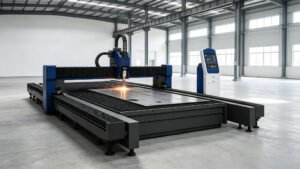
A semi-automated cell typically combines a rotary indexer, a 2D gantry, or a cobot arm with manual load/unload. The operator stages parts, selects a cleaning recipe from the HMI, and inspects before and after the cycle; the machine executes the laser path autonomously once the safety doors close. This tier fits job shops and high-mix facilities where part geometry varies daily, and it integrates into existing floor plans without conveyor modifications. It also gives operators a controlled environment to test new cleaning recipes safely, with minimal specialized programming skills.
Fully Automated Inline Systems
Fully automated lines remove human interaction from the process loop. A 6-axis robot manipulates the laser head, conveyor-fed enclosures move parts through the cleaning zone, and 3D vision systems generate dynamic paths for incoming parts. The laser scanner, extraction nozzle, and profile camera are packaged into one end-effector. Operators only monitor system health and handle upstream/downstream anomalies. This tier is built for low-mix, high-volume manufacturing: automotive chassis weld-seam prep, battery foil coating removal before ultrasonic welding, and continuous lines where any pause for manual loading disrupts the entire output.
Evaluation Dimensions
Throughput and Cycle Time
Match the cell to your line’s takt time. Calculate the surface area requiring ablation and divide by the laser’s proven cleaning speed for your contaminant; a 500 W pulse laser clears heavy rust much faster than a 100 W unit. Then check the ratio of loading time to laser time. If loading a heavy casting takes 20 seconds and the laser only needs 15, your handling time exceeds processing time — that is an argument for automation with dual-station indexing, which keeps the laser firing while the next part is loaded.
Part Geometry and Mix Complexity
Lasers need a direct line of sight. A 2D gantry handles flat plates and cylindrical shafts; the intricate cooling channels of an engine block require 6-axis articulation. Substrate sensitivity also matters: thin aluminum flanges heat up faster than thick steel bases, so the system must adjust the Z-axis dynamically as thickness or warpage varies. Vision-guided robotics eliminate expensive part-specific hard tooling by adapting the path to each part’s actual position and orientation.
Footprint and Safety Compliance
Semi-automated cells typically occupy 20–50 square feet and need only a power drop and compressed air. Fully automated lines need 100–300+ square feet for the robot, controller, chiller, extraction, and light-trapping tunnels. Both tiers require Class 4 safety enclosures with certified laser-safe viewing windows and dual-channel interlocks tied directly into the laser’s safety circuit.
| Requirement | Semi-automated cell | Fully automated line |
|---|---|---|
| Floor space | 20–50 sq ft | 100–300+ sq ft |
| Enclosure | Standalone cabinet, manual doors | Perimeter fencing with light-trapping tunnels |
| Interlocks | Door switches, e-stops | Light curtains, safety scanners |
| Ventilation | Localized extraction | High-CFM continuous extraction |
Cost-to-Value: Where the Money Goes
The laser source is only part of the capital cost. Integration hardware — robot arm, PLC, safety enclosure, exhaust system — often matches or exceeds the laser price. A semi-automated gantry cell costs drastically less to integrate than a 6-axis robotic cell with 3D vision and conveyor synchronization. Consumables are minimal for both tiers (electricity, protective lenses, extraction filters), and labor reallocation is where ROI builds: operators move from manual scrubbing to quality control and programming, scrap and rework drop with repeatable energy dosing, and tooling that no longer gets worn by abrasives lasts longer. Most high-volume facilities recover the investment within 12–24 months.
Implementation Risks and Mitigation
- Optical contamination: continuous running generates ablation dust that settles on the protective lens, heats it, shifts the focal point, and can shatter the optics. Mitigate with cross-jet air knives, high-CFM extraction at the ablation zone, and automated lens temperature monitoring.
- PLC/MES integration: the laser controller, robot, and MES must handshake in real time. Require standardized protocols (PROFINET, EtherNet/IP) and conduct factory acceptance testing that simulates real network traffic and safety interlock failures before accepting the line.
- Wrong equipment tier: buying a fully automated line for a high-mix job shop, or a semi-automated cell for a high-volume line, wastes capital either way. Size the automation level to the production volume and part variance you actually have.
Procurement Checklist
- Measure your current baseline cycle times (prep, clean, inspect) in minutes per part before requesting quotes.
- Demand cycle-time proof on your actual contaminated parts, not clean coupons.
- Ask for the integration cost breakdown separately from the laser price — then compare total installed cost.
- Confirm communication protocol support (PROFINET/EtherNet/IP/EtherCAT) and robot payload compatibility.
- Verify the enclosure meets Class 4 requirements for your specific wavelength (1064 nm) and local standards.
- Plan for training: budget operator upskilling for robotic programming, laser safety, and troubleshooting.
FAQ
Q: Why choose a pulsed laser over a CW laser for automation?
A: Pulse lasers control heat input and scan width precisely, vaporizing contaminants without melting the substrate. CW lasers act like a blowtorch and are only suitable for bulk, non-sensitive work like thick steel plate rust removal.
Q: How long does integration take?
A: Semi-automated cells typically take 8–12 weeks from design to installation. Fully automated inline systems with robotics, vision, and conveyor modifications generally need 16–24 weeks or more due to PLC programming and safety validation.
Q: Can a semi-automated cell be upgraded to fully automated later?
A: Yes — the laser source is modular and can be moved from a gantry to a 6-axis robot. However, retrofitting safety enclosures and upgrading the PLC network for dynamic tracking often costs more than buying a purpose-built line initially, so plan the upgrade path early.
Q: Does an automated laser cleaning system need a dedicated operator?
A: A semi-automated system needs an operator for loading, recipe selection, and unloading. A fully automated line runs autonomously, requiring intervention only for maintenance, optic cleaning, and system monitoring.